<Back to news
20 May 2026
Why Early Movement Matters for Girls’ Confidence in Sports
Written by Erin Lamb
Across the UK, the picture of girls in sport is changing.
By the age of 16, around two thirds of girls have stopped participating in regular sport, and over 1.3 million girls who once described themselves as sporty disengage during their teenage years.
Strangely this sits alongside something important happening at the highest level of sport. Female sport in the UK has never been more visible from elite national teams to professional leagues and global competitions. These achievements are inspiring a new generation and reshaping what girls can see as possible.
However, there is a growing gap between inspiration and participation.
While elite women’s sport continues to thrive, grassroots participation among girls is declining. This disconnect raises an important question for all of us working with children:
Why are so many girls stepping away from sport long before they ever reach adulthood?
The answer is not found at the elite level. It is found much earlier in childhood experiences of movement, confidence, and belonging. Research shows this decline could be lack of Physical Literacy. This is a concept popularised Margaret Whitehead DBE (Public Health at the University of Liverpool). It means more than just being “good at sport.” It’s about giving a child the skills, confidence, motivation, and understanding to be active for life.
This term is usually broken into four connected areas:
- Physical competence
Basic movement skills like running, jumping, balancing, climbing, and coordination. The building blocks for all sports.
- Confidence
Feeling comfortable in your body and believing “I can do this.”
- Motivation and enjoyment
Wanting to be active because it feels fun, not because you’re being told to.
- Knowledge and understanding
Knowing why movement matters and how to engage in different activities.
Developing physical literacy is so important because it is not fleeting. It helps children feel comfortable, confident, and happy in their own bodies from an early age and stays a constant as they grow into young adults. Before sport is ever about winning or competition, it should first be about feeling capable enough to join in, try something new, and enjoy moving. When children build skills like balance, coordination, and body awareness early on, they’re much more likely to see physical activity as something fun rather than something intimidating. And for girls especially, that confidence can make a huge difference later in life. Teenage girls are far more likely to step away from sport when they feel judged, embarrassed. But when movement has always felt positive, encouraging, and enjoyable, they’re more likely to stay involved. Physical literacy isn’t about creating elite athletes, it’s about helping children grow up feeling strong, capable, and confident enough to keep moving for life.
How to build physical literacy- Gymnastics as a super foundation: why this sport specifically plays an important roll
As New Zealand hockey player and parent Kelly Rawlingson shares:
“I strongly believe gymnastics provides an excellent foundation for children.
Gymnastics teaches coordination, balance, strength, discipline, confidence, and overall psychomotor skills. It also helps children develop body awareness- understanding what their body is capable of now, as well as what may be possible with time and practice.
It teaches an important life lesson too: progress often comes through small steps repeated over a longer period of time.
Gymnastics also develops key mental skills. Athletes learn how to deal with setbacks, how small details can impact performance, and how to reset and try again with focus and determination. These lessons extend far beyond sport and are valuable in education, careers, and relationships.
From personal experience as both a former gymnast and current national representative athlete, as well as a mother to a competitive Level 9 gymnast, I have seen for myself just how powerful the benefits of gymnastics can be and how much fun we’ve had along the way.”
Gymnastics is such a powerful foundation for early movement because it teaches children how to understand and control their bodies in a way very few other activities do. Before children ever specialise in a sport, they need fundamental movement skills; balance, coordination, strength, agility, spatial awareness, and body control, and gymnastics develops all of them.
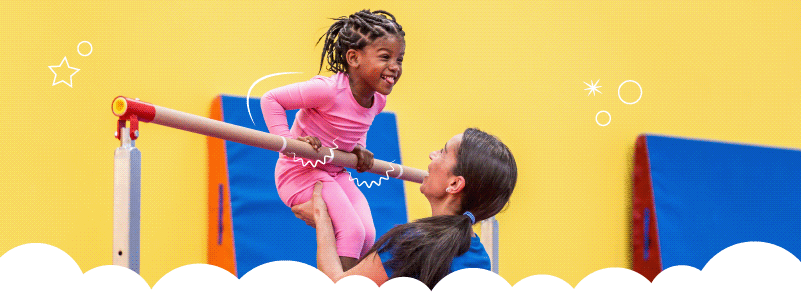
What makes gymnastics especially valuable in the early years is that it builds these skills in every direction and plane of movement. One moment they’re balancing across a beam, the next they’re upside down, hanging from a bar, or learning how to land safely after a jump. Through all of that movement, they’re building strength, coordination, body awareness, and confidence.
But perhaps most importantly, gymnastics helps children trust themselves physically. They learn that it’s okay to wobble, try again, and improve over time. That feeling of “I did it!” is incredibly powerful, especially for young girls, because confidence in movement often becomes confidence in other areas too.
That is why our curriculum is built around one simple principle:
Every child should feel successful in movement. Not by being the best, but by being encouraged to try, explore, and progress at their own pace.
Because when children, especially girls, grow up in environments where effort is celebrated and mistakes are seen as part of learning, they develop something far more valuable than physical skill.
They’re developing an important confidence.
This kind of confidence is not based on comparison or competition. It is built through repetition, encouragement, and positive early experiences in movement.
As girls grow older, many begin to face increasing pressures; changes in their bodies, social comparison, and a growing fear of judgement. National research shows that a significant number of girls begin to disengage from sport during adolescence, often linked to reduced confidence and enjoyment.
At The Little Gym, we create a supportive environment where children feel safe to try new skills, make mistakes, and keep going. Through positive early experiences, children build confidence in how they move and develop a healthy relationship with physical activity rooted in enjoyment rather than pressure.
For girls especially, this foundation can have a lasting impact. When movement becomes part of their identity from an early age, they are more likely to stay active, connected to sport, and confident in their abilities as they grow. It is not just about future sport participation, but about helping girls grow up feeling capable, supported, and confident in themselves far beyond childhood.