<Back to news
13 Apr 2026
Strong Bodies, Ready for School
Written By Heidi Lopez-Gamez
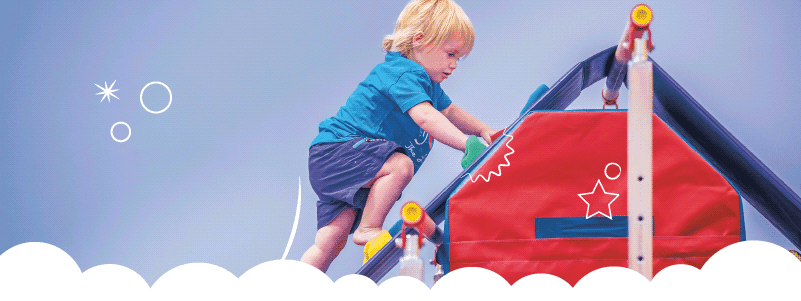
Why school readiness starts long before pencils and paper.
When we think about preparing children for school, it’s easy to focus on letters, numbers, or writing their name.
But school readiness doesn’t start with worksheets.
It starts with the body.
Before a child can sit at a desk, hold a pencil, or focus on a teacher’s voice, their body needs to feel strong, stable, and in control. And that foundation is built through something simple, yet increasingly rare: active, physical play.
At The Little Gym, we see this every day. Children who move with confidence are far more likely to learn with confidence, because a moving child is a learning child.
“I have been taking my children here for a number of years. They really encourage toddlers to learn skills in the gym that they can use in life. I’ve seen my daughters’ confidence really grow in the gym as well as outside in the parks.” — Darren Murphy
This quote perfectly captures what we see in every class: skills learned in movement settings carry over into everyday life, boosting independence and confidence long before formal learning begins.
Why this matters more than ever
Childhood has changed—and not always for the better.
The State of Play highlights that time spent playing outdoors has dropped dramatically in just one generation, replaced by more screen time and sedentary routines (Lindley, 2025). Fewer playgrounds, less safe outdoor space, and pressure on schools to deliver the curriculum have all contributed to children spending less time moving and exploring freely.
The impact is visible:
- More children are struggling with attention and behaviour in school.
- Rising concerns around wellbeing and self-confidence.
- Increasing numbers of children arrive at school below expected developmental levels.
The report also discusses “play deprivation”—a lack of rich, active play—which is linked to slower motor development, weaker social skills, and lower resilience (Lindley, 2025). In other words, many children start school without the physical foundation they need to thrive.
The body is the foundation for learning
In early childhood, learning doesn’t happen separately from movement—it happens through it.
Every time children climb, balance, crawl, or jump, they are developing the systems that support learning, including:
- Strength and stability
- Coordination and control
- Body awareness
- Focus and attention
Research from the American Academy of Paediatrics shows that physical activity supports cognitive development as well as physical health, particularly attention, memory, and emotional regulation (AAP, 2018). In practical terms, before children can sit still and concentrate on lessons, they first need to move, explore, and engage their bodies.
From climbing to handwriting: the connection most parents miss
Parents often worry about handwriting. But writing skills don’t begin at the pencil; they begin in the body.
Climbing, crawling, hanging, and supporting body weight all strengthen the core, shoulders, and wrists—the exact muscles needed for fine motor control.
According to the NHS, fine motor skills, like pencil control, rely on strong gross motor foundations (NHS, Early Years Development).
Without this physical foundation, children may:
- Tire quickly when sitting
- Struggle to grip a pencil
- Avoid drawing or writing tasks
With it, those same tasks feel far more manageable.
So when your child is swinging, balancing, or navigating an obstacle course, they are quietly building the physical skills that make classroom learning easier.
Balance, coordination, and the ability to focus
Focus isn’t just mental; it’s physical.
A child who feels restless or unstable in their body will naturally find it harder to sit still, pay attention, and engage.
Activities that challenge balance and coordination—walking along a beam, jumping in sequence, or navigating movement challenges—help children develop:
- Postural control (sitting upright without fatigue)
- Spatial awareness (understanding where they are in space)
- Bilateral coordination (using both sides of the body together)
These motor skills are closely linked to executive function—the brain’s ability to focus, follow instructions, and manage behaviour (Diamond, 2013).
In short, practising balance is more than standing on one foot; it’s about learning to concentrate, persist, and control impulses.
Why structured movement makes a difference
Free play is essential, yet structured movement adds something uniquely powerful.
In a thoughtfully designed class, children experience:
- Clear routines
- Guided activities
- Repetition with gentle progression
These experiences help children learn to:
- Listen and respond to instructions
- Transition between tasks
- Stay engaged from start to finish
These are exactly the behaviours expected in school, but developed in a way that is playful, safe, and confidence-building.
At The Little Gym, structure is intentional. Familiar routines help children feel secure, while new challenges keep them curious and motivated. When children feel secure, they are far more willing to try.
Confidence begins in the body
Movement doesn’t just build muscles—it builds belief in oneself.
Children who feel strong and capable are more likely to:
- Join in
- Try something new
- Keep going when things feel difficult
Conversely, children who feel unsure of their movements may hesitate—not because of a lack of interest, but because they lack confidence in what their bodies can do.
Every small success—a longer balance, a higher climb—builds a quiet but lasting belief:
“I can do this.”
And that belief carries into all areas of life, from playgrounds to classrooms.
Rethinking what “school-ready” really means
School readiness isn’t just about letters, numbers, or completing worksheets.
Before children can:
- Write
- Read
- Sit and listen
They need to be able to:
- Control their body
- Maintain posture
- Coordinate movement
- Feel confident trying
Physical development underpins all of this. Yet, as highlighted in The State of Play, opportunities for active play are shrinking—both at home and in schools, where breaktimes have decreased over the past 30 years (Lindley, 2025).
At the same time, studies consistently show that children are more engaged and learn more effectively when learning is active and playful.
A simple takeaway for parents
If you’re thinking about preparing your child for school, zoom out from worksheets and early reading.
The goal isn’t just to get them writing or counting early, it’s to help them feel:
- Strong in their body
- Comfortable sitting and focusing
- Confident trying new things
And that begins with movement: climbing, balancing, rolling, and exploring.
These are the foundations of learning.
At The Little Gym, every class is designed with this bigger picture in mind: helping children build strong bodies, curious minds, and confident approaches to learning, long before the first school bell rings.
Coming next
In Part 2, we’ll explore how purposeful play helps children develop the everyday learning skills they’ll need for school, from listening and turn-taking to problem-solving and teamwork.
References
Lindley, P. (2025). The State of Play: A Call to Action for the Future of Childhood.
American Academy of Paediatrics. (2018). The Importance of Play in Promoting Healthy Child Development and Maintaining Strong Parent-Child Bonds.
NHS. (n.d.). Early Years Development: Physical Development and Motor Skills.
Diamond, A. (2013). Executive Functions. Annual Review of Psychology, 64, 135–168.