<Back to news
6 Apr 2026
Introducing Our Series: School Readiness starts with Strong Bodies, Curious Minds and Confidence
Are they ready to Thrive?
A query we often hear as teachers of ages 2-4 years is: “Is my child ready for school?”
One of the most special age groups to teach at the Little Gym is pre-school. We get to be part of your little one’s transition to independence and school life. We want to take a deep dive into what a ‘school-ready’ child looks like and how and why as adults we should invest in their early years development.
Let’s re-think about what ‘School- Readiness’ actually means for a 2-3 year old
Many parents expect the answer to focus on letters, numbers, and push for early reading and writing. But in the classroom, these are not the things that determine whether a child settles, participates, and succeeds. As adults we should not worry about whether a 3-4 year old can properly write their name yet, at this early stage of development we must focus on how they think and feel, because this ultimately will have the biggest chain effect on wanting to learn in a new environment.
Children rarely struggle because they don’t recognise a letter. They struggle when they lack the confidence to try, the focus to listen, the coordination to sit comfortably, or the independence to engage with learning. School readiness is about the whole child. It starts long before a child walks through the classroom door.
At The Little Gym of Wandsworth, Chiswick, and Wimbledon, this understanding sits at the heart of our approach, supporting children not just academically, but physically, socially, and emotionally. It is what makes our programmes so effective, perfect for families looking for school preparation classes in London.
It’s Not Just What Children Know – It’s How They Feel
A child who feels strong, confident, and secure in themselves approaches everything new differently. They are more willing to join in, more resilient when things feel unfamiliar, and more able to focus on what’s being asked of them.
Children who feel:
- Confident in their bodies
- Comfortable following structure
- Able to listen and focus
- Willing to try something new
don’t just cope in school- they thrive.
This is why early years development isn’t just about knowledge. It’s about building the emotional security and physical capability that learning depends on.
Why Physical Development Matters More Than You Think
The University of Bristol have identified a ‘physical activity crisis’ in early years. They state that 1 in 4 children aged 2-4 years meet recommended daily physical activity levels.
We can link this to UK research 2025-26 which suggests:
- [ ] More children are struggling with attention and behaviour in school.
- [ ] Rising concerns around wellbeing and self-confidence.
- [ ] Increasing numbers of children arrive at school below expected developmental levels.
This will be further discussed in series 1
One of the biggest misconceptions about school readiness is that it’s primarily cognitive. In reality, physical development plays a crucial role.
Before a child can sit on the carpet, hold a pencil, or concentrate on a task, they need core strength, balance, and coordination.
In a classroom, you can identify children who have developed these skills. They sit comfortably, maintain focus for longer, and engage more confidently in activities.
Through structured movement climbing, balancing, swinging children develop:
- Core strength for posture and sitting
- Coordination for fine and gross motor skills
- Body awareness for control and confidence
The Little Gym supports those in a way that feels like play, but is actually carefully designed development. For parents searching for toddler development classes, this kind of purposeful physical activity can make a significant difference.
Learning Through Structure and Routine and thriving in group settings
Another massive part of school readiness is understanding how to function within a structured and social environment.
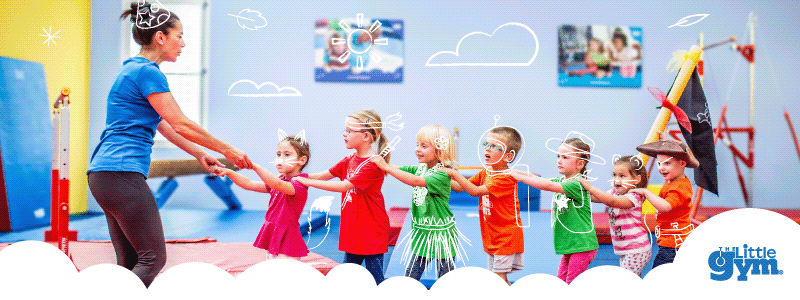
As a teacher at The Little Gym, some of our proudest moments is watching little ones who start classes with us, go from not wanting to separate from their parent, or participate in a group setting, to loving the group aspect of classes. Week by week, through movement, routine, and encouragement, we see a shift. They begin to step onto the floor independently, take part in group activities, and become excited learning alongside others. That hesitation turns into confidence, and that confidence turns into a real willingness to try.
It’s more than just progress in class, it’s a transformation. And the confidence they build in the gym follows them into school and beyond.
In school, children are expected to:
- Listen to instructions
- Take turns
- Move between activities
- Work both independently and in groups
These skills are learned through repetition, consistency, and experience.
At The Little Gym we design the classes for each age group pre-school, to closely mirror this structure. Each session follows a predictable format, helping children become familiar with transitions, expectations, and routines.
Children who are used to this kind of structure settle more quickly and feel more secure, because the environment feels recognisable rather than overwhelming.
Building Confidence Without Pressure
We talk about confidence a lot. Confidence is one of the strongest predictors of how well a child will adapt to school.
In non-competitive environments, children are given the space to develop at their own pace. They learn to take risks, make mistakes, and try again without fear of comparison.
This is something we see the impact of every day, we credit it to a unique teaching style at The Little Gym. Children who have had opportunities to build confidence in this way are more willing to participate, more resilient when they face challenges, and more open to learning.
When effort is celebrated just as much as achievement, children develop a mindset that carries far beyond the classroom.
Ready for School — and Ready for Life
When children are given the opportunity to develop physically, emotionally, and socially, they are ready to go.
They don’t just arrive at school prepared, they arrive ready to participate, engage, and grow.
They are:
- Confident in new environments
- Comfortable with structure
- Able to focus and listen
- Curious and motivated to learn
And that is what true school readiness looks like.
For families looking to give their children the best possible start, think beyond academics.
Because when children feel strong in their bodies, confident in themselves, and curious about the world around them, they don’t just start school they thrive.
Stay tuned for a 5 part series of School Readiness from The Little Gym of Chiswick, Wandsworth and Wimbledon.