<Back to news
9 Sept 2026
Birth–12 Months: How Babies Discover the World Through Movement
The Little Gym Parent’s Guide to Physical Development
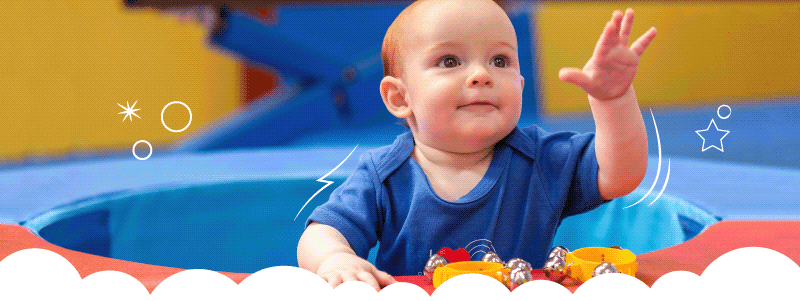
Before your baby says their first word, they are already communicating with their whole body.
A tiny hand reaches towards your face. Little legs kick excitedly during a nappy change. A baby turns their head towards a familiar voice, rolls towards a favourite toy, or stretches their whole body during tummy time.
These might seem like small moments, but they are the beginning of something extraordinary.
During the first year of life, babies are discovering how their bodies work and using movement to discover the world around them.
Every reach, roll, stretch, kick, crawl and wobble provides an opportunity to learn.
The First Year: A Time of Incredible Change
The first twelve months are a period of rapid development.
A new-born who initially relies almost entirely on adults for movement and support gradually develops the strength and coordination to control their head, move independently, sit, crawl, pull to stand and, eventually, perhaps take those first steps. But there is no single timetable for this journey.
Babies develop at different rates and may reach individual milestones earlier or later than other babies their age. Some babies crawl for months before walking, while others develop a different way of getting around. Some are constantly on the move, while others are more cautious observers. The important thing isn’t to rush towards the next milestone.
It’s to give your baby safe, enjoyable opportunities to move, explore and practise.
From Reflexes to Purposeful Movement
New-born babies are born with a number of primitive reflexes that help them respond to the world around them. You may notice your baby automatically turning towards your touch or opening and closing their hands around your finger. These early movements are largely automatic.
But as your baby’s brain and nervous system mature, their movements gradually become more purposeful and controlled. A baby who once randomly waved their arms begins reaching deliberately for a toy. A baby who once kicked their legs begins using them to push, roll and eventually move across the floor. A baby who once needed their head supported begins lifting and controlling it independently.
What starts as reflex gradually becomes intentional movement.
Tummy Time: Building the Foundations
One of the most important early opportunities for physical development istummy time.
When babies spend supervised time on their tummy while awake, they have opportunities to practise lifting and turning their head, pushing through their arms and strengthening the muscles around their neck, shoulders and trunk.
These muscles contribute to the foundations needed for later movement.
At first, your baby may only tolerate tummy time for a few moments. That’s okay. Try short, frequent periods throughout the day and gradually build up as your baby becomes more comfortable. And remember—you don’t always need a special mat or activity.
Your chest, lap or the floor can all become places for your baby to explore.
Reaching, Rolling and Discovering
As your baby becomes stronger, you’ll start to notice their movements becoming more purposeful. They may begin reaching towards interesting objects, grasping toys and bringing their hands to their mouth. They may discover that kicking their legs makes their body move. Then comes one of those exciting moments:
The first roll.
Rolling gives babies a completely new perspective. Suddenly they can change their position and move towards something that has caught their attention. They begin to discover that their movements can have an effect on the world around them.
“I moved and something happened.”
That is a powerful lesson.
Sitting: A New View of the World
As babies develop greater strength and control, they gradually become able to sit with less support and eventually sit independently.
Sitting changes everything. Instead of experiencing the world primarily from their back or tummy, babies can sit upright and use both hands to explore toys and objects. They can reach, grasp, transfer objects between hands and interact more easily with the people around them. Sitting therefore isn’t simply a physical milestone. It creates new opportunities forexploration, play and social interaction.
Crawling and All the Different Ways Babies Move
For many families, crawling feels like a huge milestone. But here’s something important to remember:
Not every baby crawls in exactly the same way.
Some babies crawl on their hands and knees. Some shuffle on their bottoms. Some roll. Some move backwards before they work out how to move forwards. Some develop their own unique style of getting around. What matters is that your baby has opportunities to develop mobility and explore their environment safely.
Research into infant motor development suggests that once babies become independently mobile, they begin to interact with their surroundings in new ways. They can seek out interesting objects, move towards people, navigate obstacles and make their own choices about where they want to explore.
That growing mobility represents an important step towards independence.
Movement Helps Babies Learn
It can be tempting to think of movement as something separate from learning.
But for babies,movement is learning.
During the first year, babies are constantly discovering cause and effect. They reach for something. They grasp it. They shake it. It makes a noise. They do it again. They drop it. An adult picks it up. They drop it again.
From an adult perspective, this can seem repetitive. For your baby, it is experimentation. They are learning:
- What their body can do
- How objects respond to movement
- How far they can reach
- What happens when they push or pull
- How to move towards something they want
- How to interact with people and their environment
Developmental psychologist Jean Piaget described this early period as thesensorimotor stage, when babies learn about the world largely through sensory experiences and physical actions.
Their bodies are one of their first tools for understanding the world.
Movement and the Developing Brain
Every movement provides information to the developing brain. When your baby reaches, rolls, kicks, grasps or crawls, different sensory and motor systems are working together.
Their brain has to process information about:
Where am I?
What can I see?
How far away is that toy?
How do I get there?
What happens if I move this way?
These experiences help build connections between the brain and body. And because babies are constantly combining movement with sights, sounds, touch, communication and relationships, physical development is closely connected to many other areas of development.
Movement, sensory exploration, communication and social connection are happening together.
The Importance of Proprioception and the Vestibular System
You may have heard the termsproprioceptionandvestibular system before. They sound complicated, but they are simply two of the systems that help babies understand movement and their bodies.
Proprioception
Proprioception helps us understand where our body is in space. For babies, experiences such as pushing through their arms during tummy time, reaching for toys, kicking their legs or eventually crawling provide valuable information about their body position and movement.
The vestibular system
The vestibular system is located in the inner ear and helps the brain process movement, balance and changes in position. As babies move their heads, roll, sit, crawl and eventually stand, they are experiencing changes in position that help this system develop. Together, these sensory systems contribute to a baby’s growing understanding of:
“Where is my body, and how is it moving?”
Pulling to Stand, Cruising and Those First Steps
Towards the end of the first year, many babies begin discovering the world from a standing position. They may pull themselves up using furniture. They may stand while holding onto something. They may begin cruising sideways along furniture. And then, eventually, those first independent steps may appear. For parents, this can feel like a huge moment.
But remember:
Walking is a process, not a deadline.
Some babies take their first steps before their first birthday. Others take longer. A baby who is still happily crawling after their first birthday isn’t necessarily behind. Development happens at different rates, and there is a broad range of typical development. The goal isn’t to get babies walking as quickly as possible.
The goal is to give them opportunities tostrengthen, explore, practise and build confidence.
Fine Motor Development: Little Hands, Big Learning
While gross motor development gets much of the attention during the first year, your baby’s fine motor skills are developing rapidly too. Watch those little hands. Your baby may begin by briefly grasping your finger or an object placed in their hand. Gradually, they become more purposeful. They reach for toys. Hold objects.
Transfer them from one hand to the other. Bang them together. Drop them. Pick them up. Explore different textures. These experiences help develop hand strength, coordination and control. And those tiny movements are laying foundations for future skills such as feeding themselves, turning pages, drawing and eventually writing.
What Can Parents Do at Home?
You don’t need expensive equipment or complicated activities to support your baby’s physical development. Everyday play can provide wonderful opportunities.
1. Enjoy tummy time
Offer short, supervised periods of tummy time while your baby is awake. Get down on the floor with them. Talk to them. Sing. Place an interesting toy nearby. Your face can be the most motivating “toy” of all.
2. Create space to explore
Whenever it is safe to do so, give your baby opportunities for floor-based movement. Rolling, stretching, pivoting, reaching and eventually crawling are much easier when babies have space to move.
3. Encourage reaching
Place toys just within reach so your baby has an opportunity to stretch, reach and move towards them. Don’t worry if they don’t get there immediately. The attempt is part of the learning.
4. Play together
Peekaboo, songs, nursery rhymes, clapping games and copying your baby’s movements combine physical development with communication and connection.
5. Follow your baby’s interests
If your baby is fascinated by something safe, let them explore it. Babies are naturally curious. Their curiosity is one of the engines driving their development.
Every Baby Develops Differently
Perhaps the most important thing to remember during your baby’s first year is thatdevelopment is individual. It can be very easy to compare. Your friend’s baby is already crawling. Someone else’s baby is already walking. Another baby seems to be sitting independently for hours. But comparing babies can create unnecessary anxiety. Your baby has their own body, personality, experiences and developmental journey. Instead of focusing solely on whether your baby has reached the next milestone, look at the progress they are making.
Are they becoming stronger?
Are their movements becoming more purposeful?
Are they increasingly interested in their surroundings?
Are they finding new ways to interact with you and the world?
These small changes are all part of the bigger picture. If your baby loses skills they previously had, or you have concerns about their development, speak to your health visitor or GP.
Quick Milestone Guide: Birth–12 Months
| Age | What you may notice |
|---|---|
| 0–3 months | Lifts their head during tummy time, brings hands towards their mouth, kicks their legs energetically and begins briefly grasping objects. |
| 4–6 months | Rolls, reaches for toys, pushes up on their arms and begins sitting with support. |
| 7–9 months | Sits independently, transfers objects between hands and may begin crawling or another form of self-directed mobility. |
| 10–12 months | Pulls to stand, cruises along furniture, may take first independent steps and develops increasingly precise hand movements. |
Remember:milestone guides describe typical patterns of development, not strict deadlines. There is considerable variation between individual children.
 The Little Gym Parent Reminder
During your baby’s first year,you are often their favourite toy.
Your voice. Your face. Your hands. Your encouragement. Your smile.
Getting down on the floor and exploring alongside your baby doesn’t just encourage movement, it creates connection.
So sing the song again. Play peekaboo one more time. Celebrate that wobbly roll. Cheer when they reach for the toy.
And when they finally manage something they’ve been practising for days, celebrate with them.
Because to your baby, that little movement might be a very big achievement.
The First Year Is Just the Beginning
From those first tiny kicks to those unforgettable first steps, your baby’s first year is a remarkable journey. But the most important thing isn’t how quickly they reach each milestone. It’s the experiences they have along the way. Every opportunity to move gives your baby another opportunity to explore. Every new movement helps them understand their body. Every successful attempt builds confidence. And every shared moment with you strengthens the relationship that makes exploration feel safe.
Your baby isn’t just learning how to move.
They’re learning:
“I can explore.”
“I can try.”
“I can make things happen.”
“I can discover.”
And those are foundations that will continue to grow long after the first birthday.
What’s Next?
As babies become confident movers, a whole new world opens up.
In the next article inThe Little Gym Parent’s Guide to Physical Development, we’ll explore the exciting—and sometimes exhausting—toddler years:
1–3 Years: Building Independence Through Movement
From those first confident steps to running, climbing, jumping, throwing and proudly declaring“I can do it!”, we’ll look at how movement helps toddlers build independence, confidence, coordination and resilience.
Sources & Further Reading
- Adolph, K.E. & Hoch, J.E. (2019).Motor Development: Embodied, Embedded, Enculturated, and Enabling. Annual Review of Psychology, 70, pp. 141–164.
- Center on the Developing Child at Harvard University. (2023).InBrief: The Science of Early Childhood Development.
- NHS. (2025).Best Start in Life: Early Learning and Development.
- NHS Cambridgeshire & Peterborough Children’s Health. (2025).Developmental Milestones.
- Piaget, J. (1952).The Origins of Intelligence in Children. New York: International Universities Press.
- Thelen, E. & Smith, L.B. (1994).A Dynamic Systems Approach to the Development of Cognition and Action. Cambridge, MA: MIT Press.